

A wallet can connect to a decentralized application in seconds, yet that does not mean the user understands what will happen next. The counterintuitive reality is that the most dangerous part of a DeFi transaction often occurs before the blockchain records it: a user may approve a request without recognizing which contract is acting, what asset it can access, or how the resulting state will change. dApp integration, smart contract interaction, and portfolio tracking are therefore not separate conveniences. Together, they form an interpretation layer between human intent and machine-executed finance.
That distinction matters for US DeFi users managing assets across Ethereum, layer-2 networks, and other compatible chains. A wallet is not merely a key holder or an address book. It is also a translator, a warning system, and—when designed well—a place to test a transaction before signing it. But every one of those functions has limits. The useful question is not whether a wallet makes DeFi “safe.” It is whether it helps the user identify uncertainty early enough to make a better decision.
Myth: connecting a wallet means trusting the dApp
Reality: connecting usually exposes an address and enables an application to prepare requests; it does not automatically give the application control over the wallet’s funds. The important distinction is between viewing information, signing a message, approving token access, and authorizing a transaction. These actions are often presented through similar browser prompts, but their consequences are materially different.
A typical token swap illustrates the chain of events. First, the dApp constructs a transaction containing a destination contract, a method call, parameters, and a fee configuration. The wallet displays or interprets that request. The user then signs it with a private key, and the network’s validators or sequencers process it. If the transaction includes an ERC-20 approval, the user may also be granting a contract permission to spend a specified amount of a token later, depending on the approval design. The swap itself and the permission to spend are related, but they are not the same event.
This is why dApp integration should be judged by the quality of the information it surfaces, not simply by how many applications it supports. Useful integration can show the contract being called, the assets moving in and out, the network fee, and the likely result. It can also flag patterns that deserve scrutiny, such as an unusually broad approval, a recipient that differs from the expected protocol, or a transaction whose output does not match the user’s apparent intention.
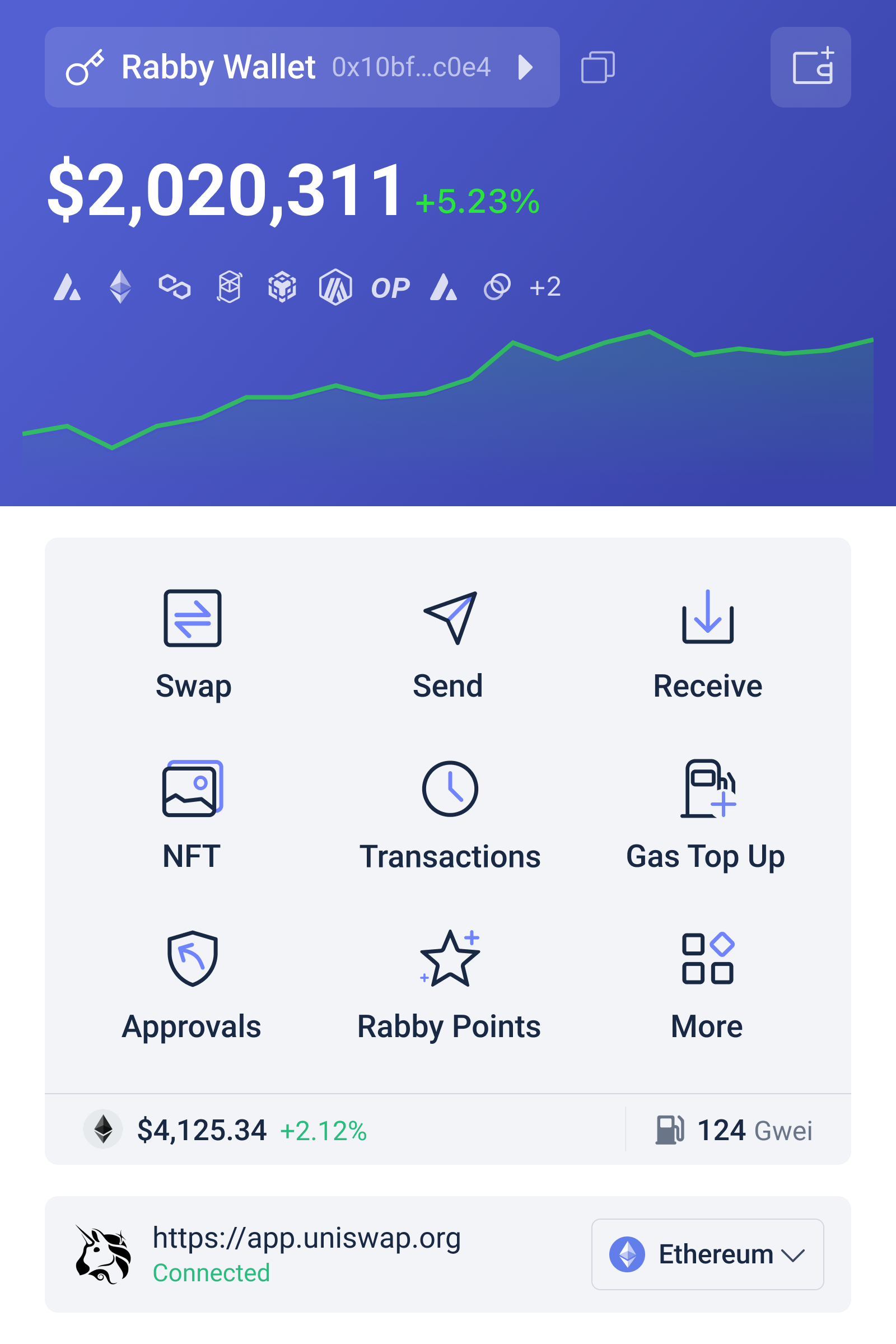
For readers evaluating an advanced rabby wallet workflow, the practical benefit is not that the wallet replaces judgment. It is that transaction simulation and security-oriented prompts can reduce the gap between raw hexadecimal instructions and a comprehensible decision. That gap is where many avoidable mistakes occur.
Myth: transaction simulation predicts the future
Reality: simulation is a conditional experiment. A wallet can often execute a proposed transaction against a representation of current or recently observed blockchain state and report expected balance changes, contract outcomes, or failures. This is substantially more informative than signing blind, but it is not a guarantee that the transaction will produce the same result when submitted.
The reason is temporal and environmental. Between simulation and execution, another transaction may change a pool’s reserves, consume an opportunity, alter a protocol position, or make a contract condition fail. A decentralized exchange may use an oracle whose value changes. A lending protocol may approach a liquidation threshold. Network congestion can affect timing, while a malicious or faulty contract can behave differently under conditions the simulation did not reproduce. Simulation quality also depends on the selected network, the RPC provider, and the state available to the simulation engine.
That limitation does not make simulation cosmetic. It changes the user’s decision process. If a proposed transaction says it will send one asset and receive another, a simulation can expose an unexpected transfer, a failed call, or a balance change that is inconsistent with the trade. It can also make an otherwise abstract approval concrete by showing which asset and amount may become accessible to a contract. In this sense, simulation is best understood as a preflight check—not a safety certificate.
A disciplined user should compare three things: the intended action in the dApp, the transaction interpretation shown by the wallet, and the post-transaction state predicted by the simulation. If those descriptions disagree, the disagreement is itself a reason to pause. The most valuable warning is often not a definitive “scam” label, but a clear indication that the requested action is more expansive than the user expected.
Smart contract interaction is a permissions problem
Smart contracts are programs deployed on a blockchain. They can hold assets, enforce rules, and call other contracts, but they do not understand human intentions. They execute the instructions encoded in a transaction. A user who thinks “I am depositing into a lending market” may technically be authorizing a token approval, a deposit call, a transfer, or several operations bundled together. The interface provides the narrative; the contract receives the mechanics.
This creates a useful mental model: every DeFi interaction has an intent layer and a permission layer. The intent layer is what the user wants to accomplish—swap, lend, stake, bridge, or mint. The permission layer is what the transaction allows a contract to do with the user’s assets. Security depends on both. A legitimate protocol can still present a risky approval structure, and a familiar interface can still route a request to an unexpected contract if the user is on a counterfeit site or a compromised front end.
Approval management is particularly important. An unlimited approval may reduce friction for future transactions, but it can increase the potential loss if the approved contract is later exploited or its control changes. A limited approval may require more transactions and potentially more network fees, yet it narrows the authorized amount. Neither choice is universally correct: frequent users may value convenience, while users handling substantial balances may prefer tighter permissions and periodic revocation. The decision should reflect exposure, not habit.
There is another boundary condition that security prompts cannot eliminate: a user can knowingly approve a harmful transaction, or misunderstand a legitimate but complex one. Wallet warnings are probabilistic and context-dependent. They may produce false positives, especially around new protocols or unusual contract designs, and they may not detect every attack. The safest workflow combines wallet analysis with independent verification of the domain, contract address, protocol documentation, and transaction purpose.
Portfolio tracking is an accounting model, not a single balance
Portfolio tracking sounds straightforward until assets move across networks and protocols. A wallet address may hold native tokens, fungible tokens, liquidity-provider positions, staked assets, wrapped representations, NFTs, and claims recorded inside contracts rather than as simple wallet balances. A displayed dollar value is therefore an estimate assembled from multiple data sources, pricing assumptions, and interpretations of protocol state.
The first important distinction is between custody and exposure. A token sitting in an address is visible as a balance. A lending position may be represented by a receipt token while the economically relevant value depends on accrued interest, collateral obligations, and the protocol’s rules. A liquidity position may have changing exposure to two assets rather than a static split. A bridge transfer may temporarily create a mismatch between what appears on one chain and what is available on another. Portfolio software can summarize these positions, but the summary is only as good as its coverage and valuation logic.
Tracking is also not the same as performance measurement. A portfolio can rise in dollar terms because the market rose, even while the user lost value relative to simply holding the original asset. Conversely, a position may look flat because the interface misses yield, fees, debt, or an illiquid claim. For US users, this distinction has practical importance when reconstructing transaction history or considering tax reporting. A portfolio view may help locate activity, but it should not automatically be treated as a complete tax ledger or a definitive cost-basis record.
The most useful portfolio tracker is consequently one that helps users investigate, not one that promises false precision. It should make chain, token, protocol, and transaction history legible; distinguish assets from liabilities where possible; and show when a value is estimated or unavailable. Users should be especially cautious with thinly traded tokens, stale prices, rebasing assets, and positions whose value depends on a contract state that is difficult to observe directly.
A practical workflow for safer DeFi interaction
Before signing, begin with the action rather than the interface. State the intended result in plain language: “I want to exchange this amount of one token for at least this amount of another,” or “I want to deposit collateral into this specific protocol.” Then check whether the wallet’s transaction interpretation matches that sentence. Look for the destination contract, assets sent, assets expected, approvals requested, network, and fee. A mismatch is more informative than a reassuring visual design.
Next, treat simulation as a comparison tool. Ask whether the predicted changes are economically plausible. If a swap produces an unexpected token, a much larger outgoing amount, or an unfamiliar contract interaction, stop and investigate. If the simulation fails, do not assume that repeatedly resubmitting will solve the problem; the failure may indicate insufficient liquidity, a protocol condition, an incorrect parameter, or an interaction that should not be authorized.
After execution, verify the result on the relevant network and update the portfolio picture. Confirm that the expected asset arrived, that an approval was created only where intended, and that the transaction hash corresponds to the correct chain. Periodic review of approvals and inactive positions is also sensible, especially for addresses that interact with many protocols. This is less dramatic than reacting to a hack, but it addresses the durable permissions that can remain after the original transaction is forgotten.
A compact decision rule is useful: intent, permission, simulation, settlement. Intent asks what you mean to do. Permission asks what the contract is allowed to do. Simulation asks what the network currently predicts will happen. Settlement asks what actually happened after confirmation. Skipping any one of these steps creates a blind spot. The rule is not a guarantee against loss, but it gives users a repeatable process for separating ordinary complexity from genuinely unusual risk.
What to watch as wallet infrastructure evolves
The next meaningful improvement in wallet design is likely to be better translation across these four stages, provided the underlying data and contract analysis improve with it. Users may benefit from clearer distinctions between approvals and transfers, more informative representations of cross-chain positions, and simulations that expose not only balance changes but also durable permissions. These are conditional possibilities, not guaranteed outcomes. Their usefulness will depend on reliable state data, careful protocol labeling, and interfaces that avoid turning complex risk into a single simplistic color.
The unresolved problem is that DeFi remains composable: one transaction can call several contracts, and one protocol position can depend on many external assumptions. A wallet can make those dependencies more visible, but it cannot make them disappear. That is the central lesson. Advanced wallet features matter most when they improve the user’s model of the transaction—what is being requested, what may change, and what remains uncertain.
Frequently asked questions
Does transaction simulation guarantee that a DeFi transaction is safe?
No. It estimates the outcome under a particular blockchain state and execution environment. State can change before confirmation, contracts can contain behavior that is difficult to interpret, and simulations may be incomplete. Use the result as a preflight check alongside contract, domain, and permission verification.
Why can a portfolio tracker show an incomplete or inaccurate value?
Tracking systems may lack support for a protocol, use delayed or unreliable prices, miss liabilities, or misunderstand positions represented inside smart contracts. Cross-chain assets, illiquid tokens, yield-bearing instruments, and liquidity positions are especially dependent on valuation assumptions. Treat displayed totals as analytical estimates rather than final accounting records.
Should DeFi users always use limited token approvals?
Limited approvals reduce the amount a contract can potentially spend, but they can require additional transactions and fees. The appropriate choice depends on the protocol, the wallet’s balance, how often the user interacts, and the user’s tolerance for operational friction. The important point is to understand that an approval is a permission, not merely a routine step in a swap.